



- Evènements
- Publics et pédagogie
- Presse
- Publications
- Les amis du Crac
- Partenariats
- Remerciements
- Informations pratiques

07.10.12 - 13.01.13
coquilles mécaniques
Athanasios Argianas,Tauba Auerbach, Erica Baum, Lucas Blalock, Miriam Böhm, Carol Bove, Claude Cattelain, Tyler Coburn, John Divola, Simon Dybbroe Møller, Spencer Finch, Jennie C. Jones, Michael DeLucia, Euan MacDonald, Kelly Nipper, Ry Rocklen, Johannes Vogl
Commissaire: Joanna Fiduccia
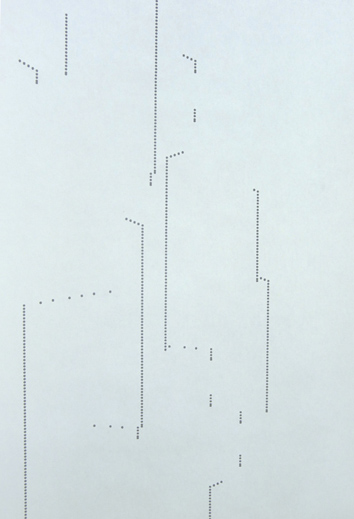 Conlon Nancarrow
Studie n°36 (détail)
Rouleau pour piano mécanique
Courtesy Wolfgang Heisig
Conlon Nancarrow
Studie n°36 (détail)
Rouleau pour piano mécanique
Courtesy Wolfgang Heisig
Au cours des années 40, Conlon Nancarrow débute une série d’études pour pianos mécaniques, s'intéressant à leur capacité d’interpréter des partitions trop complexes à jouer pour l'homme. Dans L’Homme et la Coquille de Paul Valery, il est question de l’incapacité pour l’homme à saisir le processus naturel de la formation d’un coquillage. Dans les deux cas, ce qui est en jeu pousse à s'interroger sur le dépassement de la connaissance par la technique et la nature, ainsi qu'à à vivre une véritable expérience sensorielle.
Les œuvres de l’exposition Coquilles Mécaniques reprennent ce principe : à partir de concepts ou de protocoles simples, elles déclenchent de façon inattendue un état d’excès, parfois très léger, d'autres fois plus sauvage. Ce faisant, elles soulèvent un potentiel de sensualité, de mémoire ou d’imagination souvent enfoui. Elles illustrent ainsi nos échecs à maîtriser les choses de ce monde et font naître des représentations débridées là où nous nous attendions aux rythmes de la discipline.
Joanna Fiduccia, basée actuellement à Los Angeles, poursuit une thèse en histoire de l’art. J. Fiduccia publie dans de nombreuses revues dont Art Forum, Spike, MAP et Kaléidoscope, dont elle est éditrice associée.
+ PROJECT ROOM N°11 : Joséphine Kaeppelin
«Je pars d'une hypothèse – fiction théorique : les machines ont une subjectivité.» Comme en témoignent ses propos, les machines sont au cœur du travail de cette jeune artiste diplômée depuis 2011 de l'École Supérieure des Arts Décoratifs de Strasbourg. À travers des thèmes tels que l'impact des nouvelles technologies sur les images, les œuvres de Joséphine Kaeppelin, tout juste sorties d'une imprimante ou d'un écran d'ordinateur, confrontent la créativité de l'homme à celle des machines. Inspirée des écrits du cinéaste Vertov, cette artiste interroge une vision des choses qui serait tout à fait propre à l'objet mécanique.